Can You Motorize an Existing Awning?
If you are tired of cranking your awning open every time the sun hits the patio, the question usually comes fast – can you motorize an existing awning? In many cases, yes. But the real answer depends on the awning’s frame condition, size, age, mounting setup, and whether the original system was built to handle a motor retrofit.
For homeowners and business owners, motorization is often the upgrade that makes an awning feel like a true outdoor comfort system instead of a manual add-on. Push-button operation, cleaner function, and optional wind or sun sensors can make a big difference in how often the awning actually gets used. Still, not every existing unit is a good candidate, and forcing a retrofit onto a worn or undersized frame can cost more than it should.
Can you motorize an existing awning without replacing it?
Yes, many retractable awnings can be motorized without replacing the full system. If the awning has a sound frame, compatible roller tube, and enough structural integrity to handle powered movement, a motor retrofit may be a practical option.
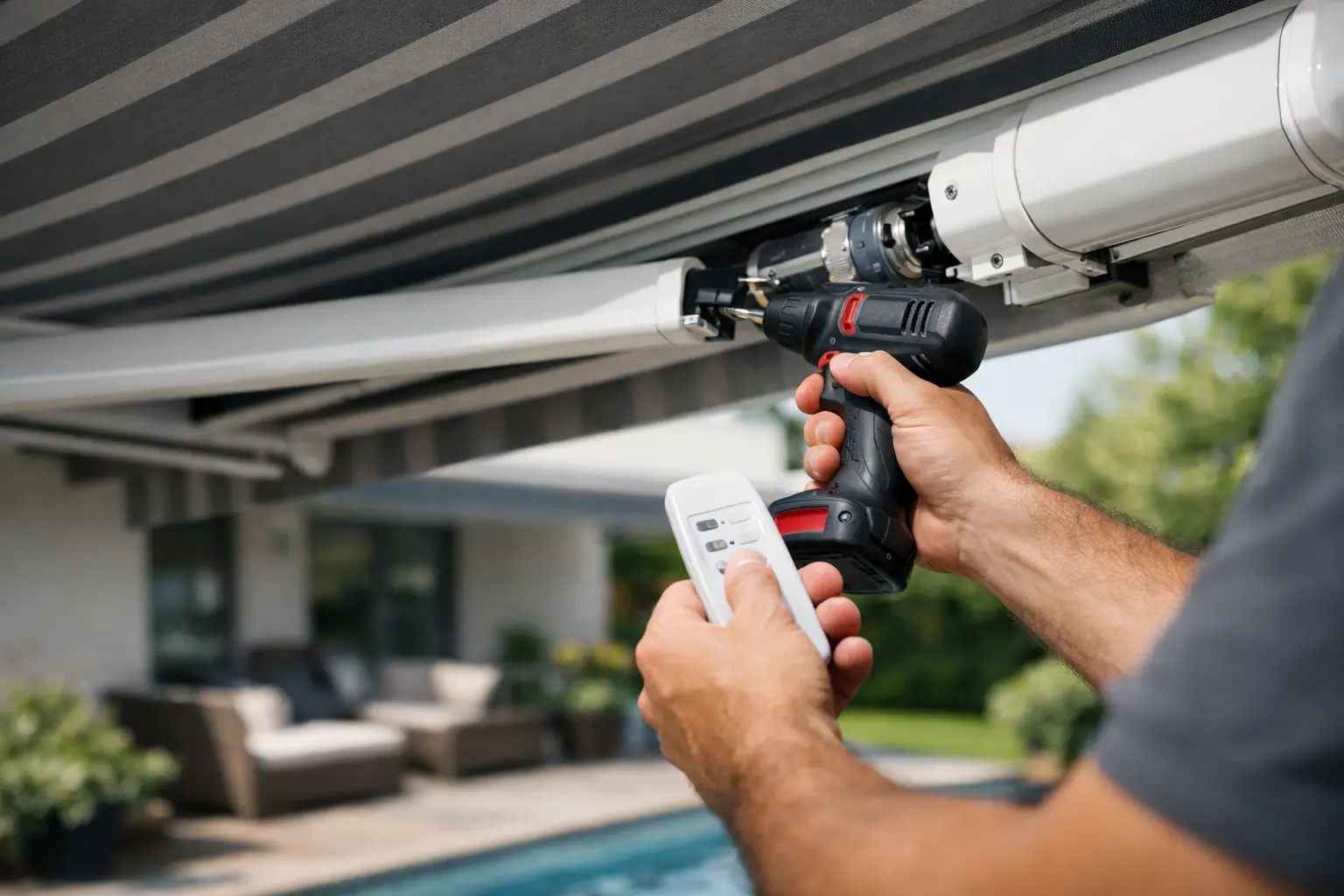
This is most common with retractable folding arm awnings that were originally sold in both manual and motorized versions. In those cases, the manual gearbox can sometimes be removed and replaced with a tubular motor inside the roller tube. Wiring or power access then becomes the next part of the job.
Where owners run into trouble is assuming every awning can be upgraded. Fixed awnings, heavily worn retractable units, or low-cost imported systems with limited replacement parts may not be worth converting. If the arms are loose, the fabric is near the end of its life, or the mounting is questionable, motorizing the old unit may only postpone a larger replacement.
When a motorized awning retrofit makes sense
A retrofit makes the most sense when the awning is structurally solid and already worth keeping. If the frame is in good shape, the extension is smooth, and the fabric still has useful life left, adding a motor can be a smart upgrade.
This is especially true for larger awnings. The wider the unit, the more noticeable the benefit. Manual operation on a small residential awning may be manageable. On a wide patio awning or a commercial storefront system, the effort adds up quickly, and users are more likely to leave it closed simply because operating it is inconvenient.
Motorization also makes sense when access is awkward. If the crank is hard to reach, if furniture blocks the path, or if staff members are opening and closing the awning throughout the day, a motor can improve usability right away. In a restaurant or café setting, that convenience is not minor – it affects speed, staff effort, and how consistently the space is used.
Signs your existing awning may not be a good candidate
The easiest way to waste money is to motorize an awning that should really be replaced. A retrofit depends on more than whether the awning opens and closes today.
If the fabric is badly faded, torn, or sagging, you may already be near the point where a full refresh makes more sense. The same goes for bent arms, weak spring tension, rusted hardware, or wall brackets that no longer inspire confidence. A motor will not fix those issues. In fact, powered operation can put extra demand on a system that is already struggling.
Compatibility matters too. Some older awnings were not designed around modern motor components. The roller diameter may be wrong, the drive side may be incompatible, or parts may no longer be available. At that point, custom adaptation can turn a simple upgrade into an expensive workaround.
What is involved in motorizing an existing awning?
Most retrofits start with an inspection. The installer checks the awning type, frame condition, tube size, projection, mounting style, and current operating mechanism. That tells you quickly whether a motor kit is realistic or whether a replacement system is the better investment.
If the awning is suitable, the manual gear is removed and a tubular motor is fitted into the roller tube. Depending on the model, the system may use a hardwired wall switch, a handheld remote, or both. Some owners also add automation features such as wind sensors, timers, or smart controls.
Power access is one of the biggest practical issues. If there is no nearby electrical source, the installation becomes more involved. That does not always make the project unworkable, but it can affect cost and scheduling. A clean retrofit is not just about making the motor fit – it is about making the whole system operate safely and look finished.
Cost: retrofit vs replacement
Cost is where many decisions become clear. Motorizing an existing awning is often less expensive than replacing the entire system, but not always by as much as people expect.
If your current awning is in good shape and compatible, a retrofit can be a cost-effective upgrade. You keep the frame, keep the existing fabric if it still performs well, and gain the convenience of motorized operation. That is the best-case scenario.
If the awning needs fabric replacement, bracket reinforcement, electrical work, and custom motor adaptation, the numbers can shift quickly. In those cases, putting money into an older system may not deliver the long-term value you want. A new motorized awning can give you updated components, a fresh warranty, stronger performance, and cleaner integration from the start.
For many property owners, the right question is not just, “Can this be motorized?” It is, “Should I put more money into this unit, or am I better off with a new one?”
Why professional assessment matters
This is not a project where guesswork pays off. Awning motorization affects moving parts, mounting loads, electrical components, and overall safety. A poor retrofit can lead to uneven operation, premature motor wear, or stress on the arms and brackets.
A professional assessment helps you avoid buying the wrong parts or upgrading a unit that has already reached its limit. It also gives you a realistic picture of whether your current awning can deliver the convenience you want without compromising reliability.
For properties in Toronto and the GTA, working with an experienced local installer matters even more because weather exposure is part of the equation. Wind, rain, seasonal temperature swings, and snow-related wear all affect how well an older awning will handle a retrofit. At Welda Solar Shading Systems, this is exactly why site review and product fit come first.
Should you add sensors and controls too?
If you are already motorizing the awning, it is worth considering a few practical upgrades at the same time. A remote control is the most common addition, but wind sensors are often the more valuable feature.
A motorized awning is convenient. A motorized awning with wind protection is smarter. If the weather changes quickly or the awning is installed in an exposed location, automatic retraction can help protect the system from unnecessary strain. Sun sensors and timers can also improve comfort, especially for commercial patios that rely on more consistent shade management.
The right add-ons depend on how the space is used. A backyard patio may only need simple remote control. A restaurant or hospitality setting may benefit from automation that reduces staff involvement and protects the investment.
The best next step if you want a motorized awning
If you are asking whether you can motorize an existing awning, you are already past the point of wanting convenience. The next step is finding out whether your current system is worth upgrading.
That means looking at the frame, the age of the awning, the fabric condition, the power access, and the total cost compared with replacement. Sometimes a retrofit is the clear winner. Sometimes a new motorized system gives better long-term value with fewer compromises.
A good installer should be able to tell you the difference quickly and honestly. That kind of guidance saves time, avoids wasted spending, and gets you to a better result faster.
If your awning still has life left in it, motorization can turn an underused patio cover into something you actually use every day. If it does not, knowing that now is still a win – because the right shading system should make outdoor space easier to enjoy, not harder to manage.