Residential Awning Buying Guide
A patio that is too hot at noon or unusable in light rain usually does not need a full renovation. It usually needs better shade. This residential awning buying guide is built for homeowners who want to make that decision once, make it well, and avoid paying twice for the wrong size, weak hardware, or features they never use.
What a residential awning buying guide should help you decide
Most buyers start by looking at fabric colors or photos of finished patios. That is understandable, but it is not the best place to begin. The real buying decision is about how you want the space to function. Do you want afternoon sun control, rain protection over a dining area, a cleaner look above a deck, or a system that opens and closes with a remote? Your answer changes the type of awning that makes sense.
A good awning should do more than provide shade. It should make your outdoor area more usable, reduce heat gain near windows and doors, and fit the style of the house without looking like an afterthought. For many homeowners, the best result is not the cheapest model on paper. It is the one that matches the space, the exposure, and how often the area is actually used.
Choosing the right awning style for your home
Retractable awnings are the most common choice for residential use because they offer flexibility. You can extend them when the sun is strong and retract them when you want open sky or when weather conditions are poor. This makes them especially practical for patios, decks, terraces, and backyard seating areas.
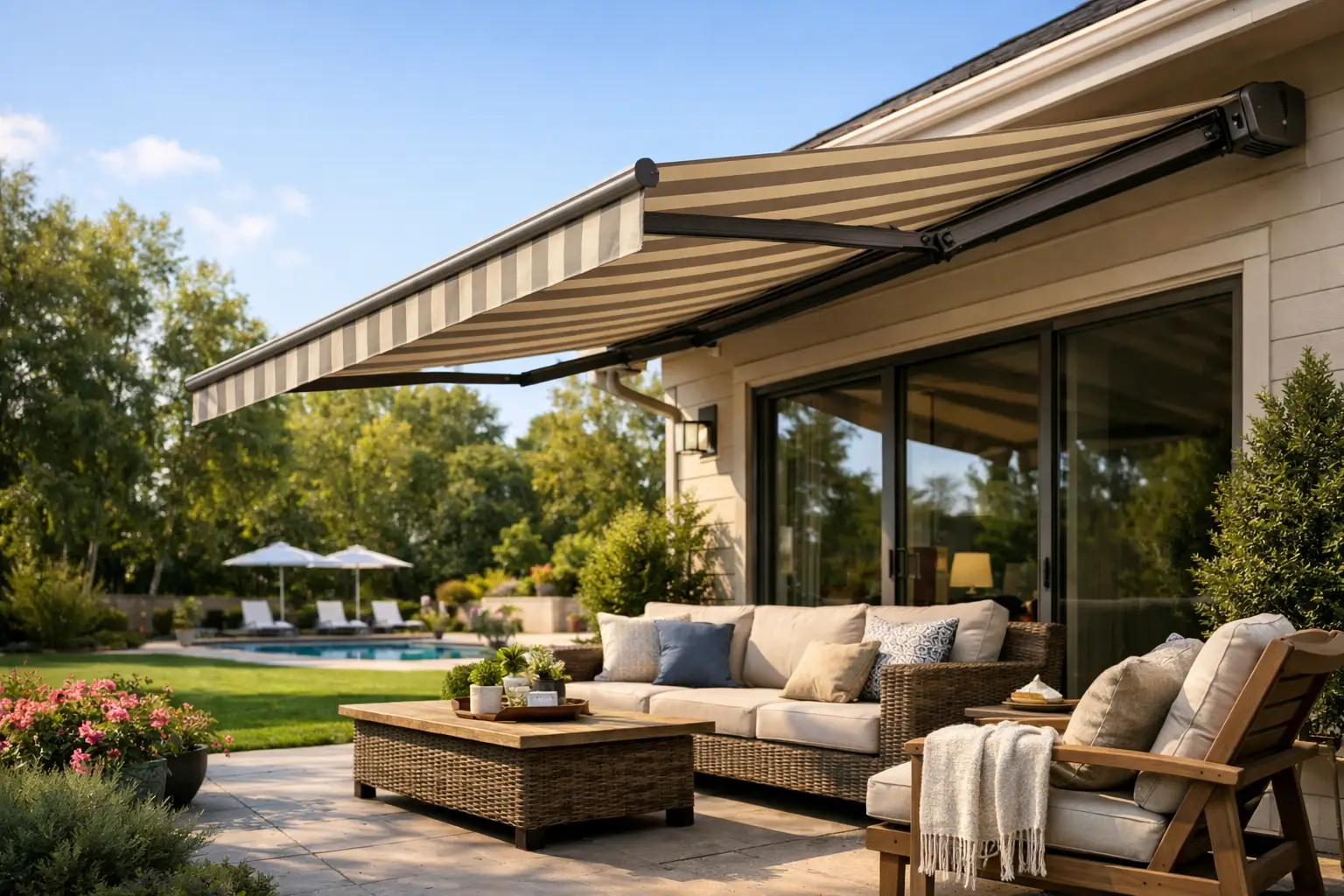
Folding arm awnings are popular when you want broad coverage without vertical posts interrupting the space below. They work well over entertaining areas where clear movement matters. Full-cassette awnings take protection a step further by enclosing the fabric and moving parts when the awning is closed. That adds cost, but it also helps preserve the system over time, especially when appearance and long-term cleanliness matter.
Fixed awnings can work in some situations, particularly over windows or doors, but they are less versatile for larger outdoor living areas. If your goal is adaptable patio comfort, retractable systems usually offer better value. The trade-off is that moving parts and motorization require better-quality components and proper installation.
Size matters more than most buyers expect
One of the biggest mistakes in any residential awning buying guide is treating width and projection like minor details. They are not. An awning that is too narrow leaves seating exposed. One that extends too little may shade the wall but not the people sitting underneath it.
Start with the actual footprint you want to cover, not just the wall space available. Measure your table, seating layout, grill clearance, and walking area. Then think about sun angle. A west-facing patio often needs a different shading strategy than a south-facing one because late-day sun can be harsher and lower.
Larger awnings can dramatically improve comfort, but they also place more demand on the mounting surface and hardware. That is why custom sizing and site-specific planning matter. The right dimensions should balance coverage, structural support, and how the awning looks when extended and retracted.
Wall conditions and mounting surface
Not every exterior wall is equally suited to support an awning. Brick, concrete, wood framing, and mixed facades all require different mounting approaches. Buyers often focus on the awning and forget the structure behind it. A strong product installed on the wrong substrate is still a weak system.
This is one reason professional consultation matters. A proper assessment can confirm whether the intended location can handle the load and whether spacing, height, and pitch will work as expected.
Fabric quality is not just about appearance
Fabric is where many homeowners see the design value first, but performance matters more than pattern alone. Awnings are exposed to UV rays, moisture, airborne debris, and seasonal temperature changes. Lower-grade fabric tends to fade faster, stretch unevenly, or show wear earlier than expected.
Look for materials designed for outdoor use with solid UV resistance, color stability, and mildew resistance. The right fabric should also complement the house rather than dominate it. Neutral tones often age well, while stronger stripes or high-contrast colors can make more of a design statement.
There is no single best choice for every property. Lighter shades can keep an area feeling brighter, while darker tones may hide dirt better and create a more defined visual edge. The smarter approach is to choose a fabric that suits both the architecture and the maintenance expectations of the homeowner.
Frame strength and weather performance
Awnings are not all built to the same standard. Frame quality affects how stable the system feels, how well it operates, and how long it lasts. Aluminum frames are common because they resist rust and keep weight manageable, but the grade of the material and the design of the arms and joints still matter.
For homes in climates with changing weather, durability should be a central buying factor. Wind tolerance, hardware quality, and arm tension are not glamorous details, but they have a direct impact on reliability. A well-built awning should feel controlled in operation, not flimsy or unstable.
It also helps to be realistic. A retractable awning is excellent for sun and light weather protection, but it is not a permanent roof replacement. If you want all-season coverage or heavier structural performance, a pergola or louvered system may be the better fit. That is where many buyers benefit from comparing options rather than forcing one product to do every job.
Manual or motorized?
Motorization has become one of the most requested upgrades because it makes larger awnings easier to use. If an awning is hard to open, some homeowners simply stop using it. A motorized system removes that friction and makes the product more practical on a daily basis.
Remote control operation is convenient, but the bigger advantage is consistency. The awning can be extended and retracted smoothly without the effort required by a manual crank. For wider systems, that matters. Some homeowners also prefer integrated sensors and smart controls, especially when convenience and protection are priorities.
Manual awnings still have a place, particularly for smaller installations or buyers focused on budget. They can be a practical option when simplicity is the goal. The trade-off is ease of use. If the awning will be used often, motorization is usually worth serious consideration.
Installation is part of the product
An awning should never be viewed as a fabric purchase with brackets added at the end. Installation affects safety, performance, appearance, and lifespan. Poor pitch can lead to water pooling. Weak anchoring can reduce stability. Incorrect placement can block doors, lighting, or sightlines from inside the house.
Professional installation also helps align the awning with the way the space is actually used. The right mounting height, projection, and angle can make the difference between shade that works at noon and shade that works when your family is sitting outside at 6 p.m.
For homeowners in Toronto and the GTA, this is especially relevant because products need to be chosen with local weather exposure in mind. A showroom consultation and site review can simplify the selection process and reduce the guesswork.
Questions to ask before you buy
A strong buying decision usually comes down to asking better questions. What conditions is the awning built for? Is the size custom-fit or standard? What does the warranty cover? Are replacement parts and service available later? Can the unit be upgraded with motorization, lighting, or sensors?
You should also ask what happens after the sale. Delivery, installation, adjustments, and product support all matter when you are investing in a long-term exterior improvement. A lower price can lose its appeal quickly if service is limited or the system is not properly fitted to the home.
When a higher upfront cost makes sense
Not every homeowner needs the most advanced system, but very cheap awnings often become expensive in other ways. You may get less durable fabric, weaker arm construction, limited sizing, or poor operation. Over time, that can mean more maintenance, shorter lifespan, and lower satisfaction.
Paying more makes sense when it buys better structural quality, a cleaner cassette design, smoother motorization, or a custom fit that actually solves the problem. That is where experienced guidance helps. Welda Solar Shading Systems works with homeowners who want practical recommendations, custom options, and installation support rather than a one-size-fits-all answer.
The right awning should make your outdoor space easier to use, not more complicated to manage. If you focus on function first, then match the style, size, and features to the home, you will end up with a shade solution that feels right every time you use it.