Best Awning for Deck Spaces: What to Pick
A deck that sits in full sun at 2 p.m. is not doing you many favors. If the boards are too hot to walk on and your seating area is empty most afternoons, the best awning for deck comfort is the one that actually matches your space, exposure, and how you plan to use it.
That sounds obvious, but this is where many buyers get stuck. They start by looking at price or color, when the better place to start is coverage, mounting conditions, wind exposure, and whether they want a fixed structure or a retractable system. A deck awning is not just a shade accessory. It changes how often you use the space, how comfortable it feels, and how much control you have over sun and light rain.
What makes the best awning for deck use?
The short answer is this: for most homes, a retractable awning is the best fit because it gives shade when you want it and open sky when you do not. That flexibility matters on a deck more than it does in many other outdoor areas. Morning sun, afternoon heat, tree coverage, nearby walls, and changing weather all affect how useful a permanent cover will feel.
A retractable system also lets you protect the awning itself. If strong wind or a heavy storm rolls in, the fabric can retract instead of staying exposed. That usually improves long-term performance compared with low-cost fixed fabric setups that remain out all season.
Still, there is no one-size-fits-all answer. The best choice depends on how large your deck is, whether it faces south or west, and whether appearance matters as much as function. A compact deck attached to a townhouse may need a slim, full-cassette awning. A wide backyard entertainment area may need a large folding arm model with motorization and a projection deep enough to cover dining and lounge zones.
Retractable awnings are usually the smart starting point
For residential decks, retractable awnings solve the biggest real-world problem: too much sun at the wrong times, but not all the time. That is why they are often the first product professionals recommend.
Manual retractable awnings can work well for smaller decks or buyers focused on budget. They offer shade without the higher cost of automation, and they are straightforward to operate. If the awning is modest in size and used occasionally, manual control can be enough.
Motorized awnings make more sense once the system gets wider, heavier, or used daily. They are easier to extend and retract, which matters when weather changes quickly. Add-ons like wind sensors and remote controls improve convenience, but they also protect the investment by reducing the chance that the awning stays out when it should not.
Full-cassette models are especially appealing if you want a cleaner look and stronger fabric protection. When retracted, the arms and fabric are enclosed inside the cassette. That tends to keep the unit looking sharper over time and helps reduce wear from dirt and weather exposure.
When a pergola is better than an awning
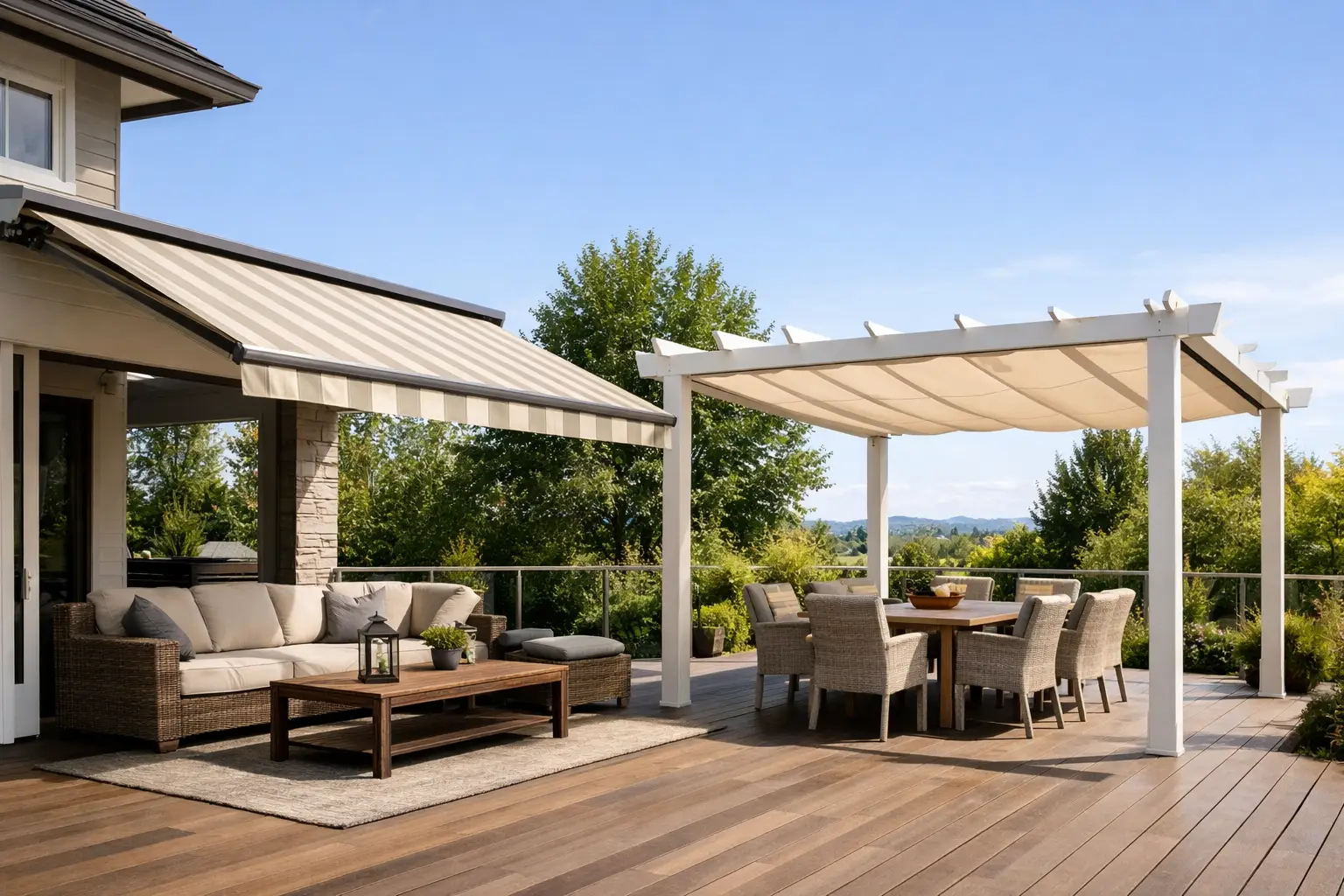
Some deck projects need more than overhead shade fabric. If your goal is to create a more permanent outdoor room, a pergola system may be the better answer.
This is especially true for larger decks, high-wind locations, or spaces where you want integrated upgrades such as lighting, heating, privacy screens, or insect protection. An aluminum louvered pergola gives more structure and often better all-weather usability than a standard retractable awning.
The trade-off is cost, footprint, and overall visual impact. A pergola is a stronger architectural statement. It can be the right move if you want to use the deck like an extension of the home, but it is not always necessary for a straightforward shade problem.
Size and projection matter more than most buyers expect
A common mistake is choosing an awning based only on the width of the deck. Width matters, but projection matters just as much. Projection is how far the awning extends outward, and that is what determines whether your dining table or seating area actually ends up in shade.
If the awning is too shallow, you may still get direct sun in the late afternoon. If it is too large for the wall and deck layout, the proportions can feel awkward and the mounting may become more complicated.
This is where custom sizing has real value. The best awning for deck coverage is usually not an off-the-shelf size picked from a warehouse list. It is a system matched to the deck depth, wall condition, mounting height, and sun angle. A few extra feet in the right direction can make the difference between occasional shade and daily use.
Fabric quality is not a small detail
People often treat fabric like a style choice, but on a deck awning it is a performance decision. Better fabric handles UV exposure, resists fading, and keeps its shape longer. It also affects how much heat and glare reach the seating area below.
Lighter colors can keep the space feeling brighter, while still reducing direct sun. Darker fabrics can create stronger shade but may make the area underneath feel visually heavier. Pattern selection also matters more than many expect. A striped or textured fabric can hide dirt and wear better than a flat solid color.
What matters most is that the material is built for outdoor use and suited to local weather conditions. In climates with strong summer sun, wind, and seasonal rain, cheap fabric tends to show its age quickly.
Wind, rain, and deck exposure
Not every deck gets the same protection from surrounding walls, fencing, or landscaping. A second-story deck or an open backyard platform may deal with far more wind than a covered patio near the house.
That changes the recommendation. In a more exposed setting, you need to pay closer attention to frame strength, mounting hardware, and whether retractability is enough or a pergola-style solution would perform better. Light rain protection is realistic with many awnings, but no fabric awning should be treated like a structure meant for pooling water or severe weather.
If your main concern is extending deck use during changing conditions, the best setup may combine overhead coverage with vertical shade elements. Drop shades can help block low-angle sun, increase privacy, and cut down on wind from one side. That creates a more usable outdoor area than overhead shade alone.
Should you choose manual or motorized?
For many deck owners, this comes down to usage. If you plan to open and close the awning often, motorization is worth serious consideration. It is easier, faster, and more likely to be used properly. That last point matters. Convenience often leads to better care.
If you only use the deck occasionally and want to control costs, manual can still be a practical option. But once the awning reaches a larger width, motorized operation starts to feel less like a luxury and more like the sensible choice.
A professionally installed motorized unit also gives a more polished result overall. It feels aligned with the rest of the home, especially on upgraded decks designed for entertaining.
Why installation quality affects the result
Even the best product can disappoint if it is poorly installed. Deck awnings put load on the mounting surface, and the bracket placement, pitch, and structural support all matter. That is why installation should never be treated as an afterthought.
A proper assessment looks at wall construction, clearance, drainage, sun path, and how the awning will interact with doors, windows, lighting, and railings. It also helps avoid the common problems that show up later, like awkward arm placement, weak pitch for rain runoff, or shade that misses the main seating area.
For custom projects, showroom guidance and site measurement are often what turn a good idea into the right purchase. Welda Solar Shading Systems works with homeowners and commercial clients who need that kind of custom-fit planning rather than a guess-and-hope approach.
The best awning for deck value is the one you will use
The cheapest option is not always the best value, and the largest system is not automatically the best one either. A well-sized retractable awning with good fabric, reliable hardware, and professional installation usually delivers more day-to-day benefit than an oversized product chosen for appearance alone.
If your goal is simple shade for a family deck, start with a retractable awning. If you want a more complete outdoor living setup with stronger structure and upgrades, look at pergola systems. Either way, the right choice comes from how your deck is used, not from a generic best-seller list.
A good awning should make your deck feel like the part of the home you meant it to be in the first place – comfortable, usable, and worth stepping out onto even when the sun is strong.